
Factors Influencing Children’s Immunization Uptake in Alberta:
- Oct 24, 2023
- 4 min read
Multilevel Interventions in a Social-Ecological Context.
Embracing a multilevel perspective in studying population health represents a significant shift in health science over the past few decades. (Galea, 2015). Within this approach, I'll use the Social-Ecological Model (SEM) to understand how determinants at different levels interact and impact vaccination rates in Alberta. The SEM focuses on individuals and their interactions within the broader social system, ultimately influencing health outcomes. Within the SEM, there are five influence levels: Intrapersonal, Interpersonal, Institutional, Community, and Policy. Interventions considering interactions across multiple levels, whether upstream or downstream, are considered multilevel (Michael Stellefson, 2019).
Figure 1.
Levels of the Social Ecological Model.
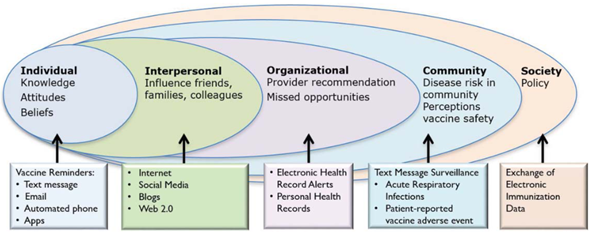
Note. From “The use of technology to promote vaccination: A social-ecological model-based framework,” by C. Kolff, V. Scott, & M. Stockwell. (2018, p. 1637). Human Vaccines & Immunotherapeutics, 14(7), 1636–1646. Copyright 2023 by Informa UK Limited.
Children's vaccination programs are essential and effective in preventing serious infectious diseases (Alabadi et al., 2023). However, suboptimal uptake, attributed to factors like parental choices, misinformation, complex schedules, and limited access, remains the primary challenge. In Alberta, the North, Central, and South regions under Alberta Health Services (AHS) exhibit lower immunization rates (70% to 84%) for routine childhood vaccines compared to the more urban Edmonton region (Chiem et al., 2022). To address this disparity, we'll explore the issue at different SEM levels and identify interventions.
Intrapersonal Level
Various methods can be used to share vaccination information with children's families and send appointment reminders. Classic reminder calls have become less effective, especially for rural patients (Chelsea A. Kolff et al., 2018). With the widespread of cell phones, large-scale text messages can overcome call-related challenges and conveniently reduce no-shows (MacDonald et al., 2022). According to Statistics Canada (2021), 88.1% of Canadians own smartphones. This opens the potential for using applications like MyHealth.Alberta.ca (Alberta Health Services, 2023) to access information and book appointments anytime, anywhere.
Interpersonal Level
The close network of family and friends greatly influences parents' views on vaccine safety. Sharing anti-vaccine misinformation on social media fuels vaccine hesitancy and lowers vaccination rates. Province-wide healthcare professional-led social media campaigns are vital for promoting evidence-based vaccine discussions. Studies have shown social media's effectiveness in vaccine education (Chelsea A. Kolff et al., 2018). Trustworthy online tools, like those from the Government of Alberta (2023), provide reliable information. The Government of Canada's immunization webpage is helpful in countering vaccine misinformation (Government of Canada, 2023).
Community Level
Incomplete immunization is prevalent in low-income communities, increasing children's susceptibility to preventable diseases. Parents often base vaccine hesitancy on media-driven concerns like autism links. Encouraging open communication with healthcare providers can resolve these issues. Also, to boost vaccination rates, consider solutions like extended clinic hours and nurse home visits. (Chiem et al., 2022).
Organizational Level
Albertan children's vaccination rates can improve with tools like vaccine registries and electronic health records, aiding clinicians in recommending vaccines proactively (Chelsea A. Kolff et al., 2018). AHS implemented the Connect Care Network, ensuring province-wide access to medical records for all patients, and promoting continuity of care (Alberta Health Services, 2021). These systems reduce false alerts and alert fatigue, complementing earlier discussed text message reminders at the intrapersonal level, and demonstrating interaction within the SEM framework.
Policy Level
In 2022, the Edmonton region welcomed 22,000 newcomers, surpassing the previous peak in 2016 by over 20% (Edmonton Global, 2023). Newcomers face barriers in navigating the healthcare system, affecting children's vaccination rates. These include transportation, language and access to family physicians (Fullerton et al., 2023). Policymakers can create more effective, inclusive policies by considering multiple levels of influence on newcomers and their communities, ensuring that children from diverse backgrounds have equitable access to vaccinations.
Embracing a multilevel SEM perspective provides a comprehensive approach to understanding and improving children's immunization uptake in Alberta. This approach considers interventions at every level of influence, ranging from intrapersonal to policy, thus preventing infectious diseases and protecting the well-being of children.
References
Alabadi, M., Pitt, V., & Aldawood, Z. (2023). A Qualitative Analysis of Social-Ecological Factors Shaping Childhood Immunisation Hesitancy and Delay in the Eastern Province of Saudi Arabia. Vaccines, 11(9), 1400. https://doi.org/10.3390/vaccines11091400
Alberta Health Services. (2021, April 21). Connect Care Wave 3—Patient Care. [Video] YouTube. https://www.youtube.com/watch?v=fxZs-xyZoC8
Alberta Health Services. (2023). MyHealth.Alberta.ca. https://myhealth.alberta.ca:443/
Chelsea A. Kolff, Vanessa P. Scott, & Melissa S. Stockwell. (2018). The use of technology to promote vaccination: A social ecological model based framework. Human Vaccines & Immunotherapeutics, 14(7), 1636–1646. https://doi.org/10.1080/21645515.2018.1477458
Chiem, A., Olaoye, F., Quinn, R., & Saini, V. (2022). Reasons and suggestions for improving low immunization uptake among children living in low socioeconomic status communities in Northern Alberta, Canada – A qualitative study. Vaccine, 40(32), 4464–4472. https://doi.org/10.1016/j.vaccine.2022.06.004
Edmonton Global. (2023, February 27). 2022 immigration trends in the Edmonton region | Alberta, Canada. https://edmontonglobal.ca/news/attracting-and-retaining-international-talent-in-canda/
Fullerton, M. M., Pateman, M., Hasan, H., Doucette, E. J., Cantarutti, S., Koyama, A., Weightman, A. M., Tang, T., Coakley, A., Currie, G. R., Fabreau, G., Constantinescu, C., Marshall, D. A., & Hu, J. (2023). Barriers experienced by families new to Alberta, Canada when accessing routine-childhood vaccinations. BMC Public Health, 23(1), 1–12. https://doi.org/10.1186/s12889-023-16258-7
Galea, S. (2015, May 31). The Determination of Health Across the Life Course and Across Levels of Influence | SPH. https://www.bu.edu/sph/news/articles/2015/the-determination-of-health-across-the-life-course-and-across-levels-of-influence-2/
Government of Alberta. (2023). Immunization and routine immunization schedule | Alberta.ca. https://www.alberta.ca/immunization-routine-schedule
Government of Canada. (2023). Vaccines and immunization [Education and awareness]. https://www.canada.ca/en/public-health/services/immunization-vaccines.html
MacDonald, S. E., Marfo, E., Sell, H., Assi, A., Frank-Wilson, A., Atkinson, K., Kellner, J. D., McNeil, D., Klein, K., & Svenson, L. W. (2022). Text Message Reminders to Improve Immunization Appointment Attendance in Alberta, Canada: The Childhood Immunization Reminder Project Pilot Study. JMIR mHealth and uHealth, 10(11), e37579. https://doi.org/10.2196/37579
Michael Stellefson. (2019, May 14). Social Ecological Model. [Video]. YouTube. https://www.youtube.com/watch?v=1fJfZI5wlt0
Statistics Canada. (2021). Smartphone use and smartphone habits by gender and age group, inactive. https://www150.statcan.gc.ca/t1/tbl1/en/tv.action?pid=2210011501


Comments